

If you’ve ever tried to call a large company or chat with Amazon, you know that Artificial intelligence has changed how people shop for just about everything. In fact, most companies hide it so well you might not even realize you’re using it. Do a simple Google search – or ask “Siri”:
- “Which piano builder builds the most pianos?”
- “What should I pay for a 1995 Yamaha C3?”
- “What’s the best piano for a beginner?”
- “Yamaha vs. Kawai—which is better?”
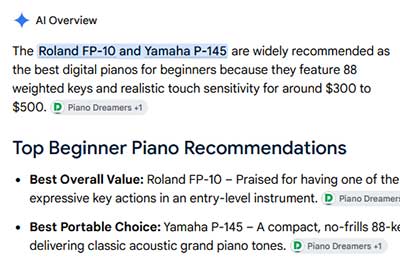
There are a number of problems with this answer. We didn’t ask for digital pianos or keyboards. We asked for the best piano for a beginner. Google’s AI assumed we wanted the cheapest option and showed us what an obscure digital piano website called “Piano Dreamers” recommended.
In seconds you’ll get an answer that sounds like it came straight from someone who’s spent 30+ years in the piano business. …but you’re not. You’re getting an answer that a specially-designed computer program has pieced together after compiling data from websites all around the world – many of which present outdated, distorted or even false information. The problem is, this computer program can’t reason. It doesn’t “think.” It has no way to recognize bias, misinformation or obsolete data.
And that is exactly where the trouble starts.
Alexa, Siri, ChatGPT, Gemini, Google’s “AI Overview” – all can be great research tools when you need to summarize large amounts of information – especially when you can cross-reference their responses with more reliable information sources. …but – just like any other experimental tool – it can malfunction – especially if you use it in the wrong way. Worse yet, AI doesn’t understand subtlety. It will present its mistakes with absolute certainty – leaving you to determine what you can and cannot trust.
So how do you get to know this new “Internet Librarian” so you can get valuable information from it without getting into trouble down the road?
That’s the tricky part.
Sounding Like an Expert Isn’t the Same as Being One
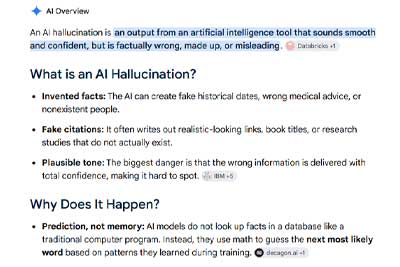
When AI gets it wrong, we call it a hallucination. Savvy users will notice that no AI platform ever says “I don’t know.” It guesses or even makes up an answer when there is no clear answer in sight.
Modern AI is an incredible tool, but it’s important to understand that it is only a tool. It’s something you use to help you accomplish a specific job. It can’t do “the thinking” for you. Let’s use the first question we asked as an example. When we asked Google which piano manufacturer builds the most pianos, it said “The Pearl River Piano Group builds the most pianos globally, producing over 100,000 instruments each year.” It also included a link to the Ohio-based piano dealer whose YouTube video made that claim. When we asked who the second largest piano builder in the world was, Google said Kawai is the second largest piano builder (by volume) in the world and it included a link to the same Ohio-based piano dealer’s YouTube video. We then asked how many pianos Kawai produces and Google said “between 10,000 and 20,000 per year” and it provided a link to Kawai Australia’s website. That seemed like a pretty big gap so – for fun – we asked how many pianos Yamaha builds per year and Google said “Yamaha builds upwards of 100,000 pianos every year.” Google also included a link to Yamaha’s blog where they make this claim. Finally, we asked Google who makes more pianos – Yamaha or Pearl River and Google said “Pearl River builds more than 100,000 pianos per year making it the world’s largest piano builder with 30% of the global market share. Yamaha builds more than 100,000 pianos a year making it the world’s second largest piano builder with 39% of the global market share.” After each sentence, Google provided links the various (competing) piano dealers who made these claims. So who builds more pianos – Pearl River or Yamaha? Clearly, you’re not going to get a clear answer from Google’s “AI Overview.”
This is the most important takeaway when working with AI: AI pulls data from all over the internet to answer your questions. It’s not giving you facts. It’s not even giving you its opinion. It’s telling you what other people think the answer is! …and – when online information is vague, outdated, or flat-out wrong – AI simply fills in the blanks with something that sounds right.
In tech terms, it’s called a “hallucination.” Even the companies building these models—like OpenAI and ChatGPT – warn users that AI frequently generates false data while sounding completely sure of itself.
Unfortunately, there’s no way you – as a Google (or “Siri” or “Alexa” or “ChatGPT,” etc.) user – can determine whether the information you’re getting is accurate – unless you check it against an another (more reliable) source.
Why AI Gets Used Piano Pricing Wrong
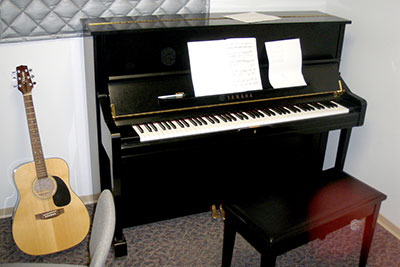
Was this Yamaha U1 seasoned for the American market or was it built to be used in Europe or Asia? You don’t know. Neither does AI. AI also doesn’t know the piano’s condition, age or resale value.
Another great way to get confusing information from AI is to ask it for an opinion. This is where piano buyers – and even reputable piano dealers – get into trouble. Remember, AI doesn’t have an opinion. It’s merely collecting opinions from competing piano dealers all over the world and regurgitating them to you with confidence. Here’s another example:
We asked ChatGPT: “What should I pay for a 1995 Yamaha C3?”
It replied: “I’d use roughly $10,000–$15,000 for a private-party purchase as a starting range, with condition making a huge difference.”
On the surface, that might sound helpful, but what does “condition making a huge difference” actually mean? How much more should you be willing to spend if the piano’s in “good condition?” How do you determine what “good condition” means? A 30-year-old piano isn’t like a 30-year-old Toyota where you plug the mileage into Blue Book and get a price. Condition IS the value. Two identical grand pianos built in the same factory in the same year can have a value difference of $10,000 or more based purely on how they were maintained. That makes this answer meaningless! …and, unfortunately, piano shoppers only see the “10,000 – $15,000” numbers and ignore the words “private-party,” “starting range,” and “condition” entirely – giving them a completely distorted understanding of what these pianos might actually sell for.
In fact, I would go so far as to say it’s useless to use AI when comparing used piano prices. Here’s why:
- Asking Prices vs. Selling Prices: AI doesn’t know the difference between what someone is asking for a piano and what they actually sold the piano for. You can list a piano for any price you want, but that doesn’t mean you can actually sell it at that price. Also, dealers commonly remove used pianos from their websites when they sell so there’s no trace for AI to read. Since there is no universal database for used piano prices, there’s no reliable data for AI to use – meaning any price it gives you is a guess at best.
- AI Can’t Look Inside the Cabinet: Technicians and reputable dealers have one massive advantage over an AI: they actually look inside the instrument and evaluate it’s true condition. Everyone says their used piano is “in good shape,” but that is rarely true. Evaluating a used piano takes experience, knowledge and care. AI simply can’t do it and, thus, can’t give an accurate value (or even range of values) on any used instrument. It just doesn’t know.
- Gray Market Pianos: Some piano manufacturers season instruments destined for use in the United States to withstand dryer indoor climate. These pianos are excellent options for American buyers (new or used). Some resellers who don’t have access to these instruments import used ones from other countries and sell them at very low prices with no warranty or oversight. These Gray Market Pianos are worth less because they often need more maintenance and service than their “Seasoned for Destination” counterparts. AI has no way of knowing whether or not this is the case so it includes lower-valued Grey Market Pianos in its used piano value estimates – driving the numbers even further down.
- Prices Change Over Time: In this example, we asked about a 1995 Yamaha C3. In 1995, it sold for around $25,000. Today, the comparable model retails for $65,000. Prices change over time. Well-maintained pianos might hold their value better than poorly-maintained ones… but which pianos hold their value includes several important factors that AI doesn’t consider – so it can’t take this into account when discussing price ranges on used pianos. …and – with over 30 years of limited sales history to average out – AI is almost guaranteed to get this one wrong.
- Finish Color: Did you even notice that we didn’t specify a finish color when we asked this question? A faded walnut C3 might be “in good shape,” but it’s far less desirable than a polished ebony one. That makes the polished ebony C3 far more valuable on the used piano market. So – since we didn’t specify which color we were considering – AI had to consider all finish colors… and that drove our prices down even more.
AI Doesn’t Know What the Best Piano Is

Digital pianos can vary dramatically in quality, performance and feature set. AI cannot evaluate these instruments’ tone or touch. All it can do is provide you with a feature-by-feature comparison. …but that doesn’t tell you whether or not you’ll LIKE a piano!
Don’t be offended, but this is another question AI can’t answer, and the reason is simple: user error. Since there is no universal answer to the question – and AI has no idea what “best” means – it simply can’t answer the question. Did you mean best acoustic piano? Did you mean best digital piano? When you say “best,” do you mean highest quality or best value? Remember, AI doesn’t think. It can’t share its opinion with you. It can only tell you what other people think and you can just imagine how many people out there are completely convinced that their piano is the best.
Believe it or not, your prompt can change the answer AI gives you dramatically. Try asking ChatGPT what color the water is at Disneyland and it’ll demonstrate how vague and unhelpful the question is. You have to be more specific. The same thing applies when asking questions about pianos. You shouldn’t ask which is the best digital piano for $3000. You should ask “Which $3000 digital pianos have the best overall service record.” You’ll get two completely different answers!
…but even if you type the perfect prompt into AI, it cannot account for human nuances. Even if Alexa recommends a Clavinova, that doesn’t mean you’re going to love the way a Clavinova sounds or feels. It may not be the best piano for you. Similarly, the right piano for a six-year-old beginner is completely wrong for a performance major. The best digital keyboard for a small apartment won’t work for someone performing for an audience in a big theater. AI doesn’t know your home, your ears, or your budget.
Even if you ask the perfect question, it regularly gives you bad information based on outdated specs, discontinued models or ridiculous advice from obscure piano forums.
Stopping by a piano dealership, working with an industry professional and personally hearing and feeling the piano (or digital piano) you’re considering is still the best way to shop for a piano. No computer program can replace that experience.
How You Should Use AI for Piano Shopping
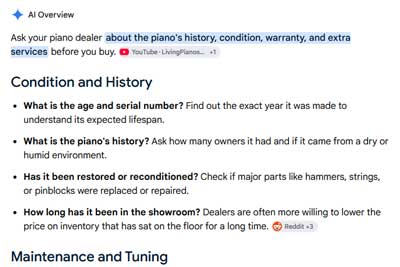
Use AI to help you prepare for real-life conversations. Don’t use it as a replacement for expert advice.
I’ve talked alot about how not to use AI, but that doesn’t mean you should abandon it completely. You know the old saying “The right tool for the right job!” …and AI is just another tool. Use it as a research assistant to prepare yourself for real-world conversations. Don’t use it in place of an expert.
AI can help you understand technical terms (like “escapement” and “voicing”). It can highlight key points in a piano brand’s history. It can even help you compare specs on new digital pianos. It can give you an excellent starting point for your research.
Don’t look to AI for answers. Look to AI for the right questions to ask your piano expert(s). Just remember to use very detailed and specific prompts. You might even try asking your questions a few different ways until you’re confident your AI tool has prepared you for further research.
The Smart Buyer’s Checklist
Use AI to build your knowledge base, but verify everything before making a purchase. No reputable piano dealer will be offended by your questions.
- Verify Specs. Remember, AI is pulling its information from other websites that could be outdated or just plain wrong.
- Hire an Independent Piano Tech: If you’re buying a used piano from a private seller, hire a piano technician to inspect it in person. That minor fee can save you thousands.
- Talk to a Reputable Dealer: Ask about service history, refurbishment details, delivery logistics, and warranty.
- Play It Yourself: No AI chatbot can describe how a keyboard responds to your hands or how a soundboard fills a room. Even if you’re not a skilled player, you should experience the piano you’re considering in person if you can.
What AI Gets Wrong About Buying a Piano

Regardless of skill level or experience, every piano player has different needs and triggers. You deserve to find the piano that will surprise and delight you for years to come and AI cannot do that for you. Just ask Google. It’ll tell you!
In a nutshell, using AI as your “piano expert” robs you of the meaningful relationship you could (and should) have with The Real Thing. We may live at a time where computer dating, webchat and e-commerce are popular, but that doesn’t mean everything is best done online. Don’t let a computer program bury you in confusion, contradiction and misinformation. Use AI to learn which questions you should ask something like: “I am looking to buy a new digital piano for my 8yr old son who likes video game music. What kind of questions should I ask my piano dealer if I want to spend less than $4000?”
AI will give you a list of questions to choose from. Each will help YOU decide which is the best piano for you and whether or not it’s a good value for your family.
Then – just for fun – ask AI “Why does AI give me wrong information when I ask questions about the piano business?”
You’ll see.


