


The most requested piano in the world, the Yamaha U1 is available as a new or used piano in the US. Unfortunately, Gray Market Piano resellers often import old U1s into the US, buff them out and sell them to Americans who don’t know their true history or internal condition.
If you’ve been shopping for a name-brand used piano – especially if that name-brand builds its pianos overseas – then you may have heard the term “Gray Market Piano.” Then again, since the companies that promote and sell these pianos often hide their true histories, maybe you haven’t.
Admittedly, the term “Gray Market Piano” sounds dramatic as if purchasing one could be unethical or even illegal, but the truth is much darker. Less reputable American piano retailers use the lure of low prices and pretty looking cabinets to convince you that the Gray Market Piano they are selling is as reliable and valuable as any other used piano made by the same manufacturer… and that they are simply offering it at a lower price because, well… “reasons.” The reality, however, is that the Gray Market Piano they are promoting is a ticking time bomb that could devastate your finances and ruin the piano’s performance with absolutely no warranty or manufacturer support. Worse yet, selling “Gray Market Pianos” is not only perfectly legal in the US, it’s commonplace. …and – if you’re not careful or well-informed – your family could pay the price.
So – before you invest thousands of dollars into any used piano – you need to understand exactly what a Gray Market Piano is, why even the piano’s manufacturer recommends you avoid it, and what could happen if you ignore the warnings and buy one anyway.
What Is a Gray Market Piano?
A Gray Market Piano is a piano manufactured by a major brand, such as Yamaha or Kawai, that was originally designed and built for use in one region (with a very specific indoor climate), but later imported and resold in another region (with a significantly different indoor climate) against the manufacturer’s recommendation.
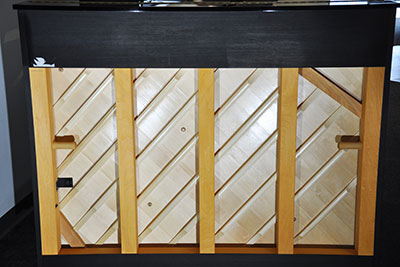
Yamaha builds the 48″ model U1 upright piano for different markets around the world. This piano was made for the US market so vital components like the soundboard, ribs, bridge and tuning pinblock were seasoned for the dry climate in American homes.
The term “Gray Market” originated in the 1820s in some financial contexts. It’s a blending of the less-common term “White Market” (which refers to goods sold through traditional retail outlets as intended by the manufacturer) and the more-common term “Black Market” (which refers to the illegal sale of goods or contraband). “Gray Market” refers to trade that is perfectly legal, yet outside approved manufacturer distribution networks. The term “Gray Market Piano” usually refers to pianos built and sold in Japan, where they are used for years before being sold at auction, refurbished, and exported overseas.
For resellers, the appeal of these instruments is two-fold: First, retailers who are not authorized to sell new Yamaha or Kawai pianos can offer these used pianos as “like new” or “refurbished” options for the value-conscious piano buyer. Second, resellers who have the infrastructure (or connections to importers) can purchase these discarded used pianos for very little money, conduct minimal “refurbishments” (often consisting of a basic cabinet buffing and some hammer filing), and sell Yamaha or Kawai pianos to American shoppers at a premium. Of course, they rarely disclose the instrument’s true origin nor do they disclose exactly what work was done to “refurbish” the instrument (a term which can mean anything you want it to).
In the end, they succeed in this business model by the power of their charisma. They hope you haven’t done your homework, you won’t ask for which region the piano was built, and you’ll believe them when they assure you that this used Yamaha or Kawai piano is just as good as the ones built for the US – just less expensive for some reason (they hope you won’t ask).
Why Are Gray Market Pianos Less Expensive?
The biggest reason piano buyers consider Gray Market Pianos is their lower price.

Used Yamaha pianos that were build for the indoor climate of American homes hold their value very well. 20-30 year old used Yamaha pianos that were imported in bulk, buffed out and sold in the “Gray Market” do not. There’s a good reason for that.
Since these instruments are used, purchased in bulk at auction, and imported outside the manufacturer’s authorized dealer network, they often sell for much less than comparable pianos sold by authorized dealers.
The reasons for this are many. First, some cultures prefer to buy only new pianos. This leaves a surplus of used pianos that have little local value. Resellers can scoop these used pianos up at auction for “pennies on the dollar.” Second, since there is no manufacturer overseeing the piano’s refurbishment, resellers don’t have to worry about quality control. They can use cheap, generic parts. They can hide or ignore serious issues. They can simply buff the piano out, file the hammers and make any claims they want about the piano’s condition with absolutely no oversight (or consequences should the piano fail). Third – in America, brands like Yamaha and Kawai hold their value fairly well in the used piano market. If a reseller can convince you that their Gray Market Piano is just as good as one built for the US indoor climate, they can sell their piano (which cost them significantly less) and make a ton of money – even if they sell their piano at a lower retail price. Finally, resellers aren’t bound by the same legal framework piano manufacturers are. They aren’t legally required to repair or replace your piano under warranty. Even if they offer you a warranty, the limitations and coverage are up to them – and no piano manufacturer will offer you support when they discover your piano is Gray Market.
In short, resellers can offer a lower price because they purchase these pianos very cheaply, put very little work into them and resell them without oversight. Buyer beware.
The Hidden Risks
So – aside from the absence of manufacturer warranty or after-the-sale support, what are the dangers associated with owning a Gray Market Piano? Why should you avoid investing your hard-earned dollars into these tinderbox pianos? Well, I’m glad you asked.
Designed for a Different Climate

Many Gray Market Piano resellers try to confuse piano shoppers by comparing the OUTDOOR climates in America… but pianos don’t go outside. We put them INDOORS… and – because of our forced air climate control systems – American homes have very dry indoor climates compared to European or Asian homes (where they use convection heating and swamp coolers).
Beware any reseller who doesn’t acknowledge the fact that pianos built for homes in Japan (where they use swamp coolers and convection heating) do not do well in American homes (where we heat and cool our homes with forced air systems). American homes have a dramatically lower average humidity than homes in Europe and Asia because we are constantly blowing air around. Some resellers try to confuse their clients by comparing the outdoor climates in Europe, Asia and the US, but you’re not putting your piano outdoors. You’re putting your piano in your home and THAT is why major brands like Steinway, Yamaha, Kawai (and others) season their pianos based on their intended destinations. These brands will dry their woods to six or seven percent moisture content for US pianos and 11-13 percent moisture content for pianos they intend to ship to Asia or Europe. They go to this extra manufacturing expense because history has taught them that failing to do so costs even more money (via warranty claims) down the road.
So, what can happen when you put a piano that wasn’t designed for American homes into the drier indoor climate? Well, the honest answer is… nothing – at least not at first. These pianos don’t explode right away. Hidden problems build up inside and cost you hundreds – even thousands – down the road. Here are common complaints:
- Soundboard cracks. Pianos that weren’t seasoned to withstand dry, American homes will shrink significantly as they dry out. This causes the piano’s vital “amplifier” to crack – leading to buzzing, tonal distortion, and projection loss. This is one component that cannot be easily replaced as everything else inside the piano has to be removed before it can be repaired. If your piano develops major soundboard cracks (common in Gray Market Pianos), it will often cost more to repair the piano that it would to replace it.
-
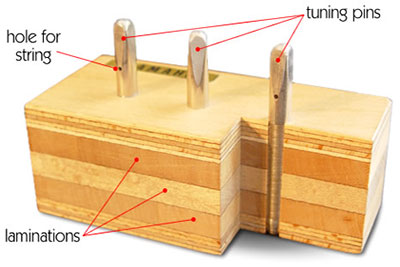
Wood is like your kitchen sponge. As it gathers moisture, it expands. As it loses moisture (ie – dries out), it shrinks. This can cause de-lamination, cracks and tuning pin slippage – meaning the piano will never be tunable again. This is an extremely expensive repair.
Pinblock Slippage. The second most expensive repair you might have to make on a Gray Market Piano is replacing the tuning pinblock. Like the soundboard, this vital wood component (which is supposed to hold the piano’s tuning pins tightly) shrinks significantly if not properly seasoned for American homes. This reduces the tuning pin torque and robs the piano of its ability to stay in tune. At best, you’ll have to tune it more and more often. At worst, some pins will slip so much they can’t hold tune at all and you’ll have to remove everything inside the piano (except the soundboard) to repair it. You can easily buy a new piano for less!
- Bridges and Case Parts Movement. Also made of sensitive wood, a piano’s bridge (which transfers tonal vibrations from the piano’s strings to the soundboard) can split or delaminate as a result of extreme dryness. Repairing this will also require replacing the piano’s strings (which can cost thousands of dollars – making it the third most expensive repair your Gray Market Piano might require). The piano’s case parts can also split or delaminate over time… and – if a grand piano’s rim splits or an upright piano’s case splits – the piano is shot!
-
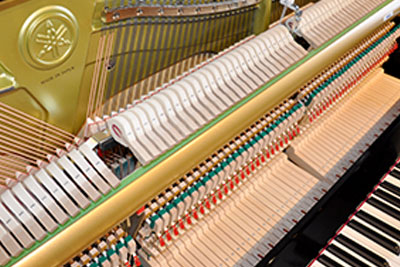
There are more than 7000 parts in a piano’s action alone – many of them tiny and made of wood. Extreme changes in temperature and humidity can warp, crack or otherwise damage these sensitive components… especially if they were never designed for American homes.
Action Component Wear. Because they are so small and precisely fitted, a piano’s key action (with over 6000 components) is very vulnerable to significant climate changes. Especially if the piano wasn’t designed to handle extremely dry air, you can almost guarantee any Gray Market Piano you purchase will require significant action adjustments at best. These small wooden components are also vulnerable to cracking and failing under stress… so be prepared to spend more maintaining a Gray Market Piano’s touch!
- Tuning Instability. We touched on this before, but it’s worth revisiting since this is the primary cost most piano owners think about when maintaining their home pianos. Gray Market Pianos aren’t designed for dry American homes. Thus, they do not hold their tune well and will cost much more to maintain.
- Performance Problems. It’s no surprise after reading the above concerns that the least expensive issue is also the most common problem. Gray Market Pianos just don’t perform as well as their White Market siblings! Especially as these pianos age, you will notice that they don’t sound or feel as good as other similar pianos.
Remember, the issue isn’t the humidity level outside (unless you happen to keep your piano in the back yard). It’s the humidity level INSIDE your home. Unless you live in a very humid state (and you hardly use your air conditioning), your Gray Market Piano is going to suffer and, eventually, give out. It’s only a matter of time.
Unknown Service History
Many Gray Market Pianos have already seen decades of use before being exported.
Unfortunately, this means American buyers have limited information about:
- How heavily the piano was used
- Whether it was maintained properly
- What previous repairs were done and what parts were used
- Whether or not the piano suffered flood or environmental damage
- How the piano was stored or transported to the US
Just like cars with beautiful chassis can have poor engines, pianos can look beautiful on the outside, but hide serious internal problems. Not knowing a piano’s service history means you can’t predict the piano’s functional lifespan. You’re just going on faith!
Misleading Marketing
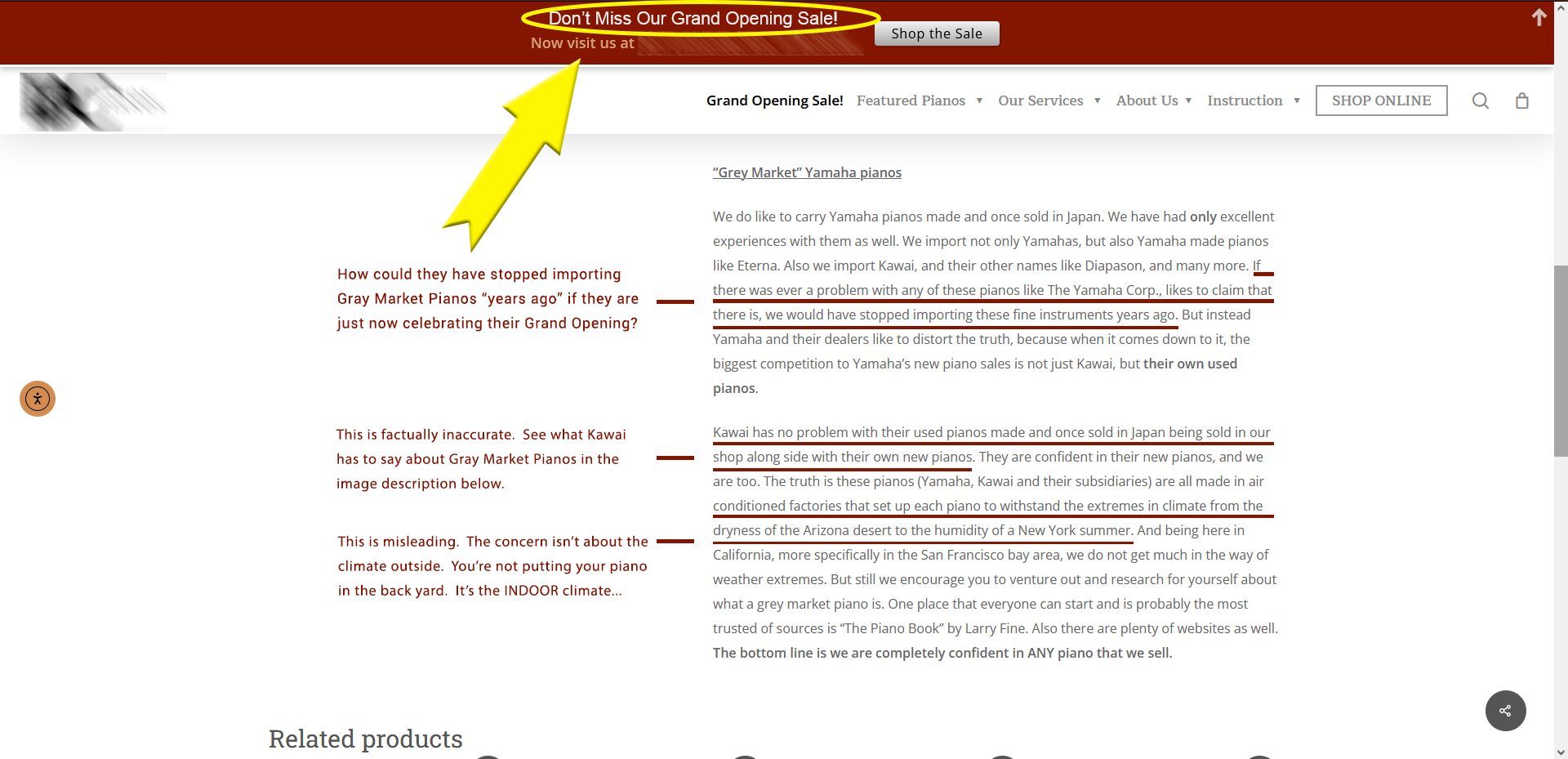
This is a perfect example of Gray Market Resellers posting misinformation to sell their unregulated used pianos. View the image to see our commentary and click here to see what Kawai has to say about buying a Gray Market Piano.
Most imported pianos undergo extensive “refinishing” or “refurbishment” before resale. These two words have no standard definition and can be used without oversight or explanation. For example: A freshly polished cabinet, new brass hardware, and clean keys can make an older piano appear almost new. However, the mechanical condition of the action, strings, tuning pins, and soundboard may be well past “end of life.”
Many Gray Market resellers will use the piano’s name brand and beautiful cabinet to convince you that the rest of the piano is just as nice.
No Manufacturer Warranty
Perhaps the most significant disadvantage is manufacturer support.
Major piano manufacturers do not honor warranties on Gray Market Instruments nor do they sell authentic replacement parts to Gray Market resellers.
That means if something goes wrong, repairs are your responsibility and you may have to use generic parts to make repairs!
Authorized dealers also receive factory training and extensive technical support – advantages that Gray Market resellers cannot access.
How Can You Tell if a Piano Is Gray Market?
It’s unlikely the reseller will offer you this information and, sadly, some of them won’t tell you the truth even if you ask. The best way to know for sure is to ask several important questions:
- Was this piano originally sold in the United States?
- Is it covered by a manufacturer’s warranty?
- Is the seller an authorized dealer of that brand?
- Will the manufacturer confirm it was intended for this market?
A reputable dealer should be able to answer these questions clearly and provide documentation.
Yamaha has even setup a website to protect used Yamaha buyers (and their own reputation as a manufacturer). All you need to do is get the piano’s serial number and enter it into this form: https://www.yamaha.com/ussub/pianos/serialnumberlookup.aspx
Yamaha will confirm whether or not the used Yamaha piano in question was designed for American homes.
What do Manufacturers Say About Gray Market Pianos?
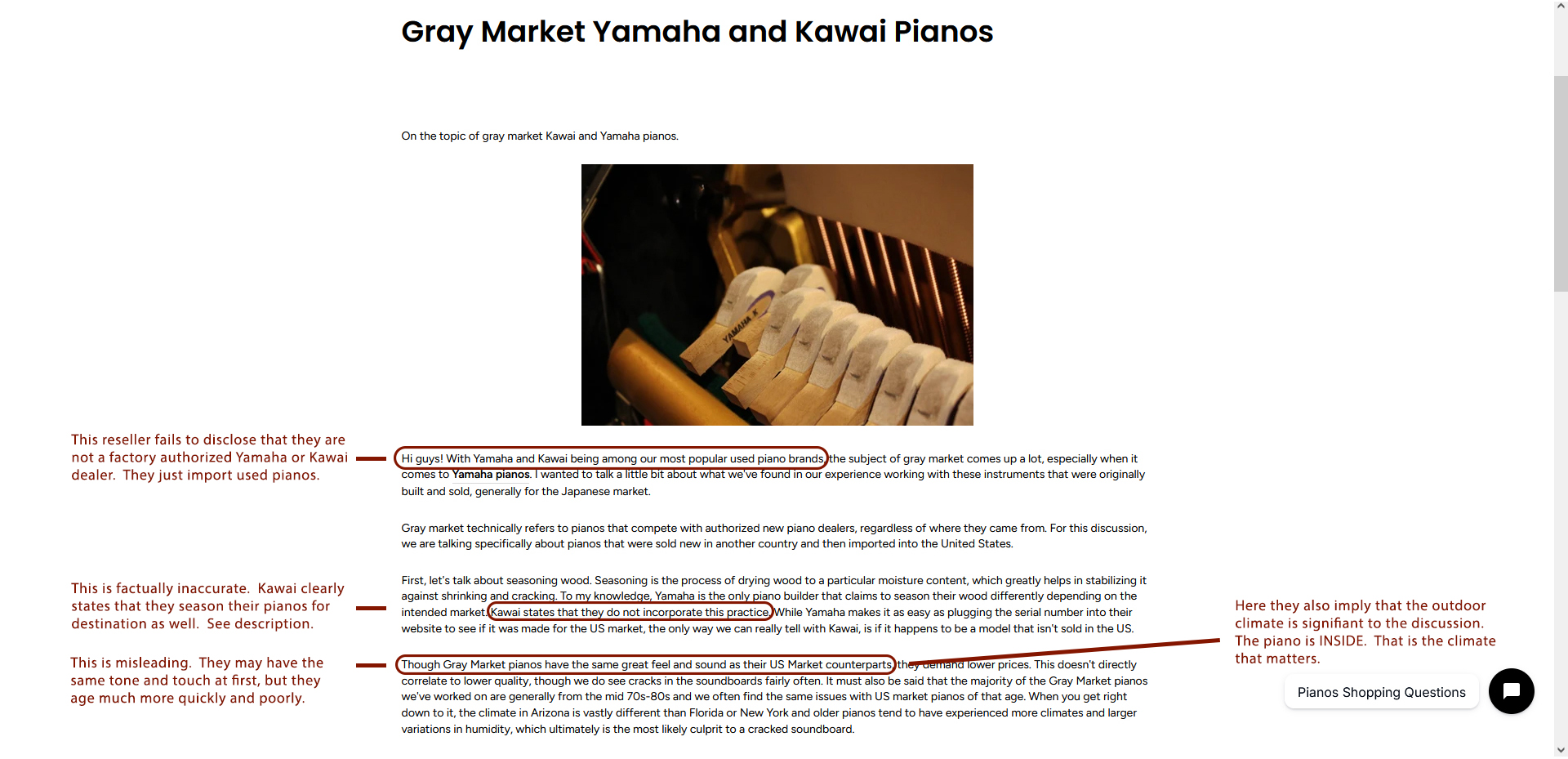
Here is another Gray Market Piano reseller posting misinformation online to sell their problematic pianos. Click the image to see our commentary and click here to see what Kawai really has to say.
A quick search of the internet reveals an alarming abundance of misinformation about Gray Market Pianos – from resellers who hope to convince you their used pianos are safe to AI platforms that often regurgitate reseller misinformation – it’s very difficult to get honest, accurate answers about these pianos. So – if new piano dealers can’t be trusted because “they want to sell you new pianos” (a common claim by Gray Market Resellers) – who can you trust for accurate information on this topic? How about the piano manufacturers themselves?
Yamaha, in particular, has been clear over the years that they do not endorse nor do they support the purchase of Gray Market Yamaha Pianos in the US. In their own blog, Yamaha emphasizes the huge risks Gray Market Pianos present and why they as a brand do not offer warranty support nor do they offer replacement parts for Gray Market Pianos.
“That’s why, when Yamaha builds pianos destined for the U.S., it seasons the critical wooden components – including the soundboard, bridges, ribs and pin block – by drying them to a much lower moisture content using computer-controlled kilns and other advanced manufacturing technologies.” – David Burben, Yamaha.
Kawai also discourages shoppers from buying Gray Market Pianos. “That’s a key reason they can be so cheap: very often, these impressive-looking instruments are nearing the end of a working piano’s expected lifespan long before they arrive…” – “What is a Grey Market Piano” (Kawai Australia)
Keep in mind that manufacturers aren’t suggesting you ONLY buy new pianos. They are suggesting that you only buy pianos designed to succeed in dry American homes. In fact, nobody is suggesting that you shouldn’t buy a used piano. Just buy the right one.
Why Buying from a Reputable Dealer Matters
Reputable piano dealers offer important advantages.
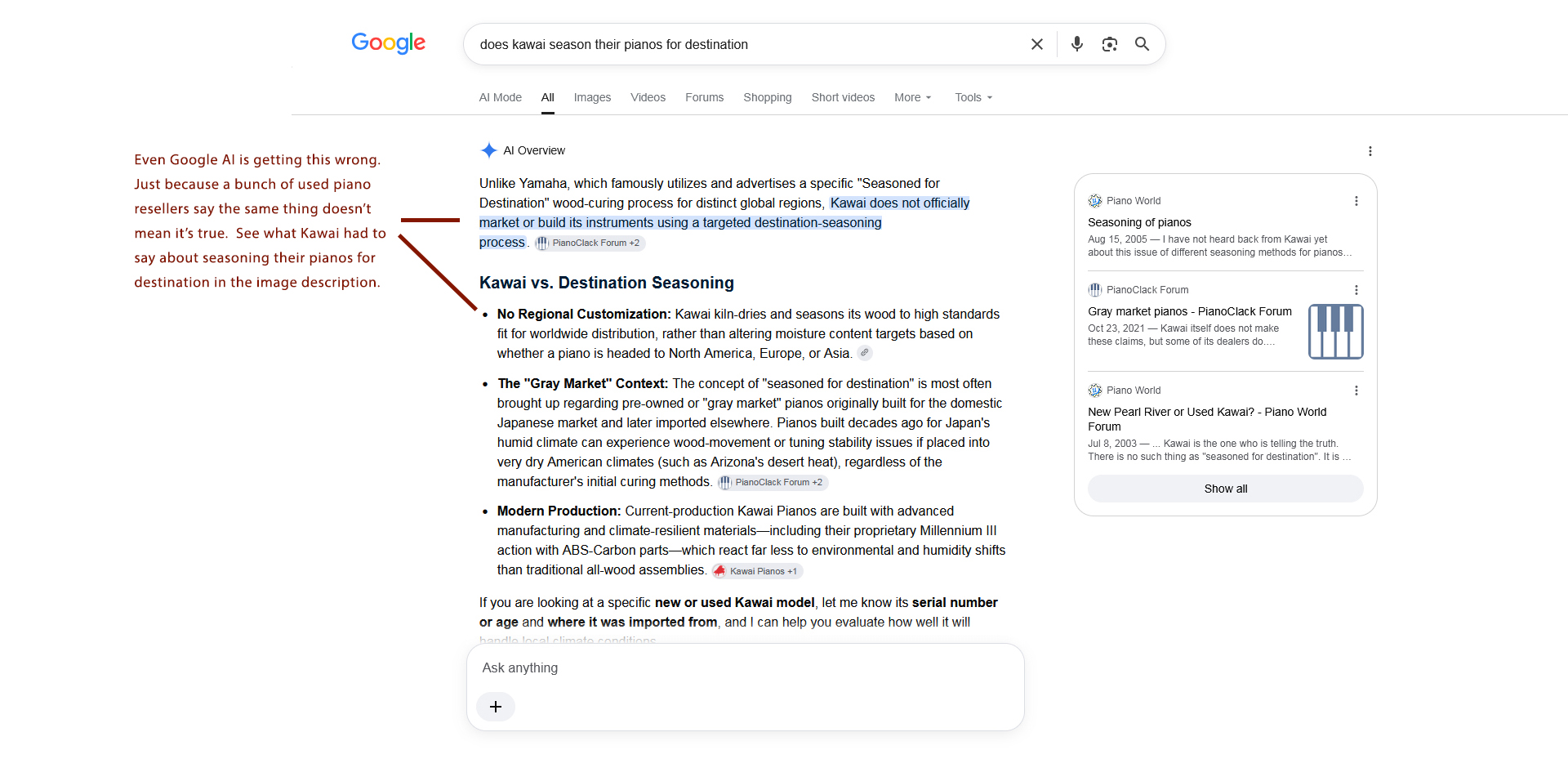
Even Google’s AI – which merely regurgitates information it finds elsewhere online – gets it wrong here. Click here to see what Kawai says about Gray Market Pianos on their own blog.
They provide:
- Factory-backed warranties
- Certified service and preparation
- Genuine replacement parts
- Professional inspections
- Ongoing customer support
- Manufacturer-approved maintenance standards
- A long history of consumer ratings and reviews
These benefits help protect your investment and provide peace of mind long after the purchase. If you’ve ever bought a new car, you know you get better care and consideration from a factory-authorized dealership than you do if you buy the same “like new” car from a used car dealer down the street. Pianos work the same way.
Are All Gray Market Pianos Bad?
Not necessarily.
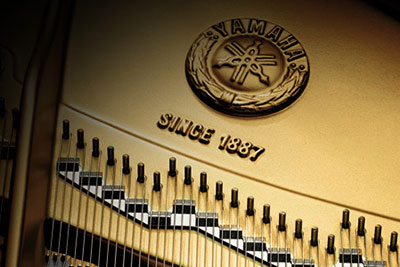
Not all used Yamaha or Kawai pianos are a bad investment. Pianos designed for American homes are great choices (new or used)… but if you’re going to buy a used piano that wasn’t intended for the US, you should be very careful.
Some gray market pianos have been carefully rebuilt by skilled technicians (with genuine factory parts) and can provide years of enjoyable service. …but how can you tell which ones have and which ones haven’t?
You can’t – and – to avoid significant expenses or disappointments down the road – that is why you have to trust the right people.
Without knowing the instrument’s complete history, restoration quality, or long-term structural condition, you assume more risk than you realize. Why risk costly problems down the road just to save a few dollars up front?
Experienced technicians or re-builders who fully understand the risks might do well with a Gray Market Piano. For most consumers, however, purchasing through a reputable piano dealer offers greater confidence and better long-term value.
Are Gray Market Pianos a Myth?
Several used piano resellers who market and sell Gray Market Pianos – and even some piano technicians who make a living “refurbishing” them (whatever that means) – want you to believe that “Gray Market Pianos” are a myth propagated by new piano dealers and piano manufacturers to prevent you from buying affordable used pianos. …but is that the truth?

Anybody can carry Gray Market Pianos. They are cheap and easy to find. …so – if a dealer chooses NOT to carry them – you should ask yourself “why.” We respect our clients enough to recommend they spend a bit more now to avoid huge repair bills later.
If new piano dealers can also carry used pianos (even Gray Market ones if they so choose), why would they fight so hard to protect you from buying one? …and why would piano manufacturers – whose brand reputation means far more to them than the occasional sale of a single used piano – discourage you from buying a Gray Market Piano?
Who will you trust – used piano resellers who have to convince you that Gray Market Pianos are desirable if they want to make a sale today – or piano manufacturers and their authorized network of new and used piano retailers who have a vested interest in your long-term success?
No. Gray Market Pianos are not a myth and you have to be VERY careful working with anyone who would tell you otherwise – especially if they use misinformation to do so.


