

When most people start their piano search, they consider criteria like price, brand, or even appearance. Unfortunately, one important factor that they either fail to consider altogether or consider for the wrong reasons is size. Of course, it’s important that the piano you choose will fit in your space, but most modern homes can accommodate at least some form of baby grand piano. The issue isn’t whether or not it will fit, but how the piano will perform in the space you allow for it. …and you might be surprised at just how much “piano” you can fit into your space if you’re willing to get creative.
Maybe you don’t think you have room for a grand piano at all! If not, this blog is definitely for you. Better understanding grand piano sizes and options can only help you in your search for your “perfect home piano.”
Common Grand Piano Sizes

Grand pianos are measured from the front of the keyboard to the back of the tail. While manufacturers vary slightly, most grand pianos fall into several general size categories:
- Digital Grand: 3’ – 5’
- Baby Grand: ~4’11” – 5’6”
- Medium / Living Room Grand: ~5’7” – 5’10”
- Parlor Grand: ~5’10” – 6’4”
- Semi-Concert Grand: ~6’5” – 7’4”
- Concert Grand: ~8’9” – 9’
Remember – there are different kinds of pianos. Traditional “wood and strings” pianos (called “acoustic pianos”) start at about 4’11” and go up from there… but digital grand pianos can be under 3’ deep! Also, grand pianos aren’t rectangles. Some can be very narrow at their longest points. Don’t rule anything out. Let your piano consultant know what space you’re working with and (s)he can help you find the best fit.
Why Bigger Pianos Often Sound Deeper
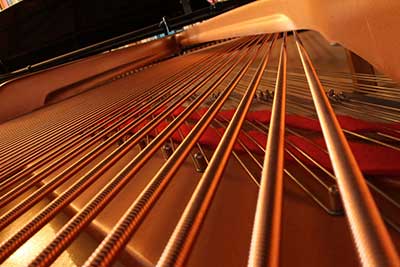
A critical factor in a traditional piano’s tone is string length. Longer pianos allow for longer bass strings, which produce:
- Deeper, richer bass
- Greater tonal clarity
- More balanced sound across the keyboard
Shorter grand pianos must fit their bass strings into a smaller space. Manufacturers compensate by increasing string thickness or tension, but physics still favors longer strings. As a result, smaller pianos can sound slightly thinner or less resonant in the low register compared to larger instruments.
When you move up even six or eight inches in length, the difference can be dramatic. With a slightly larger piano, you’ll notice a fuller, richer bass and a smoother transition between the bass and mid ranges.
Some digital grand pianos like the Roland GP-6 or GP-9 operate with an algorithm that recreates a traditional grand piano’s physics virtually. This means you can “lengthen” your grand piano digitally and recreate the performance of a much larger piano in a smaller space.
The Soundboard Factor
 Size also affects the soundboard, which is the large wooden surface that amplifies the vibration of the strings.
A larger piano has:
- A larger soundboard area
- Greater resonance
- More dynamic range
This means a bigger grand piano can produce both powerful volume and delicate softness with greater control thanks to a larger vibrating area and greater air displacement.
In smaller pianos, the soundboard simply has less space to resonate, which can limit tonal complexity and warmth.
Why a Few Inches Can Matter

One of the biggest surprises for piano buyers is how small differences in length can produce noticeable differences in sound.
For example:
- A 5’2″ baby grand and a 5’7″ grand may look nearly identical in a room.
- Yet the five extra inches can allow longer bass strings, better scaling, and improved tonal balance.
Manufacturers often design each model very carefully. Even a 3–4 inch increase can mean a redesign of the string layout, bridge placement, or soundboard crown. The result is often a piano that feels more responsive and sounds more mature.
This is why pianists frequently recommend buying the largest piano that comfortably fits your space and budget.
Construction Quality Often Improves With Size

While size alone doesn’t determine quality, many manufacturers invest more advanced design and materials in their larger models. This can include:
- Longer keys for improved control and precision
- Higher quality core wood material
- Upgraded hammer felt material
- Enhanced plate framing and reinforcement
Because of this, stepping up to the next size in a piano line often means not only a bigger instrument, but a more refined musical experience overall.
Choosing the Right Size for Your Space

Of course, bigger is not always better. A well-built baby grand piano might offer a more satisfying performance than a cheaper, larger piano. Also, technology-infused pianos (like digital grand pianos or hybrid pianos) can offer superior performance features in spaces that can’t accommodate a traditional grand piano. It’s important to find an instrument that can “fill” your space with tone without taking up the entire room.
Consider:
- Room size and ceiling height
- Acoustic treatment (rugs, curtains, furniture)
- Playing style and repertoire
- Possible technology options
In many homes, a piano in the 5’6”–6’ range offers an excellent balance between manageable size and satisfying tonal depth. …but – as always – the most important consideration is whether or not you enjoy playing the piano you’re considering. Size isn’t everything – especially if your budget is limited.
Final Thoughts
When comparing grand pianos, it’s easy to assume that small size differences are mostly cosmetic. In reality, those extra inches can dramatically improve your piano’s performance.
A slightly longer piano often delivers:
- Richer bass
- Greater tonal balance
- Increased dynamic range
- Improved construction design
If you’re evaluating grand pianos, take time to play several sizes side by side. You may be surprised at how much difference a few inches can make—not just in measurements, but in the music itself. …and don’t forget to ask us for help! We’ll show you all your options, discuss the “pros and cons” with you and help you find the perfect fit for your taste, space and budget.


You rightly mention that power and dynamic range increase with length. It’s easy to underestimate the loudness of a grand when you try it in the showroom. I realised my dream a couple of years ago and bought a Kawai Shigeru 2 (180 cm or 5′ 11″), the smallest of the series!. We mostly play it with the lid down, because the instrument is just too loud with the cover open, and the room is fairly large, 5 m x 7m = 35 m2 or .m380 sq. ft. So, even if money is no object, I wouldn’t just go for the longest instrument you can afford, but consider where it will be used, too.
Great blog btw.
Thank you, Michael, and congratulations on getting your dream piano! We agree that you need to consider how the instrument projects as well. That’s a great point. Best wishes and thanks for stopping by!