

On June 9, 1840, Franz Liszt hosted a concert in Mayfair, London’s Hanover Square Rooms. The performance was part of a two-concert series advertised as “Liszt’s PianoForte Recitals.” History records this as the first “piano recital.” …but you might be surprised to learn that – though Liszt coined the term itself – many don’t consider him to be the father of modern classical piano recitals. Why? Because they were too much fun! Seriously.
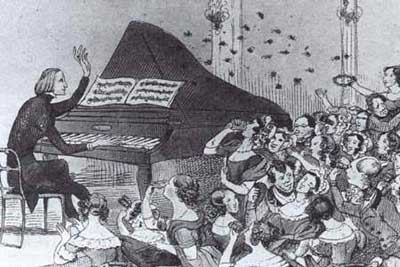
Franz Liszt’s piano recitals were so spectacular that they drove his audience into a frenzy. In 1841, Heinrich Heiene coined the term “Lisztomania” to describe the crowd’s response.
Liszt was one of the first touring pianists to engage with his audience during the performance. In fact, he would often arrange attendees in such a way that he could walk among them and chat between songs. He was the first performer to position the piano sideways so the audience could see his profile and so the piano’s tone could wash over them in a more powerful way. …but, interestingly enough, it was his tendency to spontaneously improvise from his programmed works that stirred his audience into a frenzy – causing fans to swarm over him and fight for any keepsake they could find (from broken piano strings to gloves to his leftover coffee residue). The hysteria found a name in 1844: Lisztomania. Clearly, these were not the formal happenings modern audiences associate with the term “piano recital.” In fact, they were far closer to today’s rock concerts (especially considering that the music we now call “classical repertoire” was new back then).
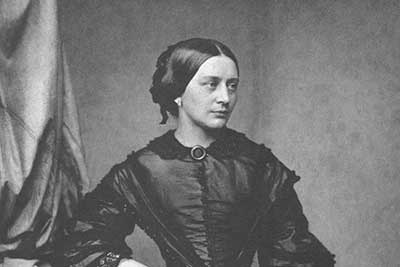
Clara Schumann invented what we now consider to be the “classical piano recital.” She was the first to play the music without embelishment and completely memorized.
How, then, did modern piano recitals become such serious affairs? That responsibility lies with Clara Schumann. When Schumann began performing in public, the concept of “classical music” didn’t exist – and neither did the concept of a “piano concert.” People played music that was recently written – almost exclusively in their homes. In fact, most of the music 19th century performers played was so new, they just read it from the page. Schumann was the first to memorize her repertoire and perform it in a serious, formal environment. Unlike Liszt, Schumann’s fame came from her (memorized) performances of older music – what we would call “classical music” today. Schumann followed the music exactly as written – with a special emphasis on respecting the composer’s original intent. To her, the beauty was in recreating the composer’s original vision for new audiences… and – thanks to her – modern piano students still perform memorized “classical music” as written in a formal recital environment.

Modern piano recitals follow in Clara Schumann’s formal tradition – though we still position the piano with its lid facing the audience as Franz Liszt did.
Now – over 180 years later – few people remember the wild experiences that were Liszt’s piano concerts. All we remember is the formal (and sometimes stuffy) tradition Clara Schumann established as the model for “classical piano recitals.” …and – for some modern studios – it’s increasingly difficult to breathe new life into these formal affairs. That doesn’t mean we should abandon them, however. Certainly there is a place for a formal event from time to time. These performances create a healthy tension that drives students to work hard and to succeed when they take “center stage.” …but, perhaps, there’s a way we can learn from BOTH Schumann and Liszt – and give modern piano students (and their families) some desperately needed variety. Here are five ways modern piano teachers can refresh their piano recital experience:
Provide a Historical Context
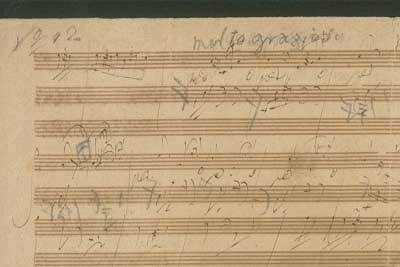
Beethoven had famously bad handwriting as you can see here. Perhaps this is why “Fur Therese” was misnamed “Fur Elise” when released after his death.
History is full of fascinating stories, amusing anecdotes and social contexts that would wow any audience. For example: Did you know that Fur Elise wasn’t written for someone named “Elise?” In fact, Beethoven dediced his famous bagatelle to someone named Therese. We don’t know for sure who “Elise” is as the song was published 40 years after Beethoven’s death. This is one of the world’s most famous classical pieces – yet most people don’t know this story! Why not infuse a little social or historical context into your next “classical” piano recital? You could share anecdotes like this one between pieces and/or even include a slideshow with images of the composers, original manuscripts, and locations or instruments associated with the music. If you want to go “all out,” you could even use a digital piano to recreate the tuning, temperament and tone of the original instruments used. How exciting would it be to hear these pieces as they sounded in the 19th century – before the modern piano took over as our primary recital instrument?! You might be surprised how a little context could breathe new life into the music – and your students’ performances!
Focus on Composition
As pianists, we spend a lot of time playing music written by other people. Why not mix things up and host a piano recital that features your students’ original compositions? More experienced students could use their theory training to create an original piece (either by hand or with a digital piano). Less experienced students could participate as well – though in a more limited way. I’ve even heard of piano teachers using a children’s books to teach composition. Using the sound effects voice on a digital piano, the student creates a “sound track” for the story. Then, the teacher works with the student to express that sound track as notes on a staff. The student can then perform their original “song” both as sound effects (played along as the teacher reads the story book) and as their first original piano piece. This delights parents and students alike – demonstrating how important the “nuts and bolts” of music theory are to the creative process.
Organize Ensembles
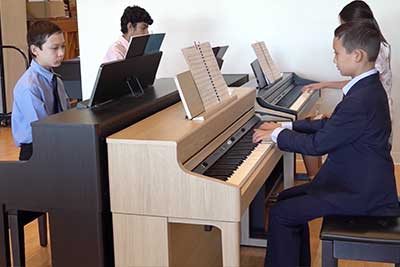
Here, four students are playing together as a band. Each pianist is playing a different part with a different sound. Click or press the photo to see the video.
Piano lessons can be a solitary experience for many students. When they do practice, most students work alone. Thus, most piano recitals feature a long stream of single student performances. Why not mix it up and organize some ensembles? Lesli Hanson is one of our Piano Education Partnership (PEP) piano teachers and she does an incredible job bringing students together for group play. [Watch this Video Example] The experience not only gives the students a much better sense of timing, it also helps them listen to what is happening around them. Of course, each student is motivated to learn his or her part because (s)he doesn’t want to be the one holding the group back. This is a great way to incorporate some fun into your recital while simultaneously giving your students better musicianship skills. Everybody wins!
Incorporate Technology
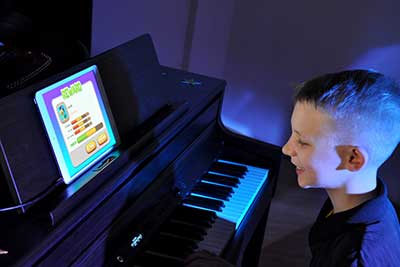
Here a piano student plays his recital piece on a digital piano with background accompaniment via the Piano Maestro app.
Another great way to make your students and their families LOVE piano recitals is to include digital pianos, Bluetooth apps and other technologies. Jennifer Foxx, another of our PEP Teacher family, recently did a recital at our Peoria store where every student performed their piece on a digital piano with full background accompaniment. Using the magnificent Piano Maestro app (via iPad), she gave each student the ability to perform their recital piece with a full band – to the delight of her studio audience. The students loved it as well! I even saw a piano teacher pre-record her own accompaniment and play LIVE with it while the audience played simple rhythm instruments (or clapped along). That performance brought down the house! …and folks are still talking about it months later. You could use a TV and iPad or notebook to stream performances from out of town students. You could record the performances privately and “stitch” them together with video editing software for a YouTube debut. With modern music technology, the options are endless! …and – if you’re not comfortable with these tools – work with your local piano store. They should have someone on hand to guide you to success!
Go Full Franz

This costumend little girl is having the time of her life as she braves Riverton Piano Company’s Masquerade Halloween recital.
Franz Liszt was a classical composer too, you know… but – as I mentioned before – he was a very different kind of performer. Who is to say you can’t emulate him from time to time and make your piano recital feel like a rock concert?! As part of our PEP Program, we do this often. We have hosted a Disney theme’d piano recital, a movie-theme’d piano recital and our legendary Halloween-theme’d piano recital (called Masquerade). We invite students from all around the area to participate in a costumed frenzy with us. We provide the professional lighting and elaborate sets. The students provide the music and their costumes… and our piano teachers just get to enjoy the show! You’d be stunned how putting on a simple costume and giving your recital a silly theme once in awhile can motivate even the most reluctant students. Just try out a few of the above links and see how much fun we’re having in those videos. Wouldn’t YOUR students love to do that as well?
Tradition is a hard thing to break, but – if it’s not serving a specific purpose – why devote yourself and your studio to it? Why not pepper in some different experiences like the ones listed above and give your piano studio more flavor? Who knows? You might find yourself as excited by the outcome as your students and their families will be!
Of course, if there is anything we can do to help you – especially if you live in the Phoenix area – please don’t hesitate to contact us. We’re excited to partner with area piano teachers and work with you to build an exciting future for LIVE music!


